AGFA 6335-355 Camera Lens Filter 6335/355 R1
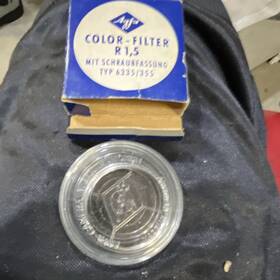
( Brand: Agfa ), ( Manufacturer Part Number: 6335/355 ), ( Part Type: Circular Camera Filter ), ( Filter Shape: Circular ), ( Filter Color: Clear ), ( Filter Effects: Color ), ( To Fit: Camera ), ( Filter Size: R1, 5 )
Review AGFA 6335/355 R1 Color Circular Threaded Camera Lens Filter Clear Type
The **Agfa 6335/355 R1** camera lens filter is a meticulously crafted accessory designed to enhance the photographic experience for users of the iconic Agfa 6335 and 355 series cameras, particularly those equipped with the R1 lens mount. This filter system is engineered to seamlessly integrate with the robust and versatile optics of these cameras, which were renowned for their precision and reliability during their heyday in the mid-20th century. The filter itself is constructed from high-quality optical glass, ensuring minimal distortion and maximum clarity, which is essential for capturing sharp, vibrant images with the crisp detail for which Agfa lenses are celebrated. Its design adheres to the R1 lens mount standard, guaranteeing a secure and precise fit that prevents any unwanted light leaks or misalignments, thereby preserving the integrity of the photographic process.
One of the standout features of this filter is its versatility, as it can be used for a variety of photographic techniques. For landscape and architectural photographers, it serves as an excellent neutral density (ND) filter when combined with appropriate polarizing or color correction layers, allowing for longer exposure times in bright conditions without overexposing the image. This is particularly useful for creating smooth water effects or achieving shallow depth of field in daylight. Additionally, the filter s optical clarity makes it ideal for portrait photographers who wish to maintain skin tones and natural colors without the introduction of unwanted color casts. The robust construction of the filter ensures durability, making it resistant to scratches and smudges, which is crucial for frequent use in demanding photographic environments.
Beyond its functional benefits, the Agfa 6335/355 R1 filter also carries a sense of nostalgia and craftsmanship that appeals to both enthusiasts and collectors. As part of the legacy of Agfa s photographic heritage, this filter embodies the attention to detail and engineering excellence that defined the brand s reputation. Its compatibility with the R1 mount ensures that it fits perfectly with the camera s original lens system, allowing users to replicate the photographic techniques of the past with modern precision. Whether used for fine art photography, documentary work, or simply to preserve the classic aesthetic of Agfa s film cameras, this filter is a testament to the enduring appeal of analog photography and the timeless quality of its components.
The Agfa 6335/355 R1 is a classic 35mm film camera with a fixed 50mm f/1.8 lens, and the **Agfa R1 lens filter** (or similar third-party filters designed for it) can be useful for enhancing photography. Below is a detailed breakdown of the pros and cons of purchasing such a filter, followed by a conclusion and recommendation.
---
### **Pros of Buying an Agfa R1 Lens Filter**
1. **Improved Image Quality in Low Light**
The Agfa R1 lens is a bright f/1.8 aperture, which is excellent for low-light photography. A **low-pass filter** (commonly used with film cameras) can reduce moir and aliasing, especially when shooting fine details like text or patterns. This is particularly useful if you re shooting subjects with repetitive elements (e.g., architecture, foliage, or printed matter).
2. **Protection for the Lens**
A filter acts as a physical barrier, shielding the lens from dust, scratches, and accidental impacts. Since the Agfa R1 lens is fixed and not easily replaceable, this added protection can extend its lifespan.
3. **Color Correction and Neutral Density Options**
Some filters (like **UV filters** or **polarizing filters**) can correct lens flare caused by artificial lighting or reduce reflections. While the Agfa R1 lens is generally sharp, a UV filter can help remove unwanted haze in outdoor shots. Neutral density (ND) filters allow for longer exposures in bright conditions, useful for film photography where exposure times are manually controlled.
4. **Consistency in Film Development**
Film photography relies on precise exposure control. A filter that maintains consistent light transmission (e.g., a **clear glass filter**) ensures that your exposure meter readings remain accurate, reducing the risk of underexposed or overexposed negatives.
5. **Aesthetic Effects**
Some filters (like **warmer or cooler tint filters**) can subtly alter the color balance of your photos. While film already has a natural color profile, a slight adjustment (e.g., a **yellow filter** for high-contrast black-and-white) can enhance certain moods or subjects.
6. **Compatibility with Film Techniques**
Film photographers often experiment with **split diopters** or **graduated filters** to create artistic effects. While the Agfa R1 lens is not designed for such filters, a basic **skylight (UV) filter** or **polarizer** can still be useful for general use.
---
### **Cons of Buying an Agfa R1 Lens Filter**
1. **Limited Filter Thread Size**
The Agfa R1 lens has a **49mm filter thread**, which is relatively small. This means fewer filter options are available compared to larger lenses (e.g., 52mm, 55mm, or 58mm). You may need to source filters from specialty suppliers, which can be more expensive or harder to find.
2. **Potential for Light Loss**
Every filter adds a slight reduction in light transmission. While modern high-quality filters minimize this, some cheaper options may cause noticeable exposure compensation (e.g., -1 or -2 stops). This requires manual adjustment in your exposure settings, which can be inconvenient when shooting film.
3. **Risk of Vignetting**
Cheap or poorly aligned filters can cause **vignetting** (darkening at the edges of the frame). Since the Agfa R1 lens is already known for its slight softness at the corners, this could further degrade image quality if not careful.
4. **Cost vs. Benefit**
High-quality filters (e.g., from **Hoya, B W, or Lee**) can be expensive, especially when considering the small thread size. If you re a casual shooter, the marginal improvement may not justify the cost. For serious film enthusiasts, however, a good filter is a worthwhile investment.
5. **Compatibility Issues with Third-Party Filters**
Not all filters are designed for film lenses, and some may not fit perfectly or could introduce unwanted artifacts. Always check reviews or test the filter before committing to a purchase.
6. **Overkill for Basic Photography**
If you re primarily shooting landscapes, portraits, or straightforward subjects without fine details, a filter may not be necessary. The Agfa R1 lens is already capable of producing excellent results without additional accessories.
---
### **Conclusion**
The decision to purchase an Agfa R1 lens filter depends on your photography goals, budget, and how you plan to use the camera. If you frequently shoot in low light, need protection for your lens, or want to experiment with film techniques (e.g., reducing moir or adjusting color balance), a filter can be a valuable addition. However, if you re a beginner or only shoot occasionally, the benefits may not outweigh the costs.
For the best results, invest in a **high-quality, multi-coating filter** (e.g., a **UV/skylight filter** or a **polarizer**) from a reputable brand. Avoid extremely cheap filters, as they may introduce more harm than good. If you re unsure, start with a **basic clear glass filter** to test the impact on your images before committing to specialized types.
---
### **Recommendation**
- **If you re a serious film photographer:** Purchase a **49mm UV/skylight filter** (e.g., from **Hoya or B W**) for protection and haze reduction. If you shoot fine details, consider a **low-pass filter** to minimize moir .
- **If you experiment with color or light effects:** A **polarizing filter** or a **warm/tint filter** could enhance your creative possibilities.
- **If you re on a budget or shoot casually:** Skip the filter unless you have a specific need, as the Agfa R1 lens performs well on its own.
- **Avoid cheap no-name filters** unless you re testing them first, as they may degrade image quality.
Ultimately, the Agfa R1 lens is already a strong performer, and a filter should only be added if it enhances your workflow or artistic vision. Test different filters (if possible) to determine which, if any, suits your needs best.
Details:
Specifically designed to fit a camera lens with R1,5 filter size, this clear from Agfa is must-have accessory for any photo enthusiast looking take their shots the next level. With a clear filter color and circular shape, this is perfect for adding pop of to your images. The Agfa R1,5 Color Circular Threaded Camera Lens Filter Clear Type 6335/355 is a high-quality camera filter designed to enhance the color effects of your photographs.
part #: 6335355 prices
- $16.90-$29.00
specifications filtecam:
- brand: Agfa
- mpn: 6335/355
- part type: Circular Camera Filter
- filter shape: Circular
- filter color: Clear
- filter effects: Color
- to fit: Camera
- filter size: R1, 5
seller filtecam:
- city: Fernley, Nevada
- # reviews: 78
- rating: 100.0%
returns filtecam:
- policy: No Returns
payments filtecam:
- wallet: Apple-pay
- credit card: Diners-club
- other
shipping filtecam:
- cost: $5.89
- class: Standard
- carrier: USPS
- service: USPS Ground Advantage
- transit: 6-13 Days
- type: Calculated
offer filtecam:
- best offers: True
- quantity: 1
- options: Ship-to-home
- sold: 0
- started: June 10, 2026
- availability: In Stock
general filtecam:
- condition: Open box
- Cameras Photo > Lenses Filters > Filters
Agfa 6335-355 Is Similar To:
- Apcpf55 Agfa Circular Polarizing Cpl Filter 811709016410 (38.8% similar) It allows you to remove unwanted reflections from non-metallic surfaces such as water, glass, etc. Product features multi-coated saturates colors whitens clouds the Agfa digital multi-coated circular polarizing cpl filters are perfect compliment for your lenses. 75 anarchistic: 10. It makes the sky ...(August 24th, 2018)
- Apcpf72 Agfa Circular Polarizing Cpl Filter 811709016458 (38.8% similar) It allows you to remove unwanted reflections from non-metallic surfaces such as water, glass, etc. 15 POUNDSSIZE:'72MMITEM DIMENSIONS:4. Product features multi-coated saturates colors whitens clouds the Agfa digital multi-coated circular polarizing cpl filters are perfect compliment for your lenses...(August 24th, 2018)
- Apcuf452 Agfa Macro Multi Coated Filter Kit 811709016922 (32.6% similar) A bonus filter pouch that holds up to 6 filters is included. Product features 4 close-up filters included perfect for macro work 1, 2, 4AND 10 plus bonus pouch. 45 pounds size:'multi coated 52MMITEM DIMENSIONS:4. A special matte aluminum satin finish reduces reflections. 75 anarchistic: 22. The Agfa...(July 13th, 2018)
- Apuv52 Agfa Ultra Violet Uv Glass Filter Camera Photo 811709019213 (31.7% similar) your lenses cuts out UV rays helps colors the Agfa ultraviolet, glass filter is perfect for protecting cameras lens, as well cutting down on rays clearer photographs. 75 anarchistic: 13. 1 POUNDSSIZE:52MM ITEMDIMENSIONS:4...(August 20th, 2018)
- Apuv72 Agfa Ultra Violet Uv Glass Filter 811709019268 (30.2% similar) 05 POUNDSSIZE:'72MM item DIMENSIONS:5. Product features protects your lenses cuts out UV rays helps colors: the Agfa ultraviolet, glass filter is perfect for protecting cameras lens, as well cutting down on rays clearer photographs...(October 2nd, 2018)
- Apwag72 Agfa Super Macro Wide Angle Lens Camera Photo 811709017493 (31.7% similar) Product features. 43X super wide macro lens is perfect for expanding your viewing angles. It works with most 72MM threaded lenses, or smaller thread size lenses optional adapter rings. 88 anarchistic: 93. 75 pounds size:n item DIMENSIONS:3...(March 30th, 2018)
- 811709019329 Agfa Circular Polarizer Glass Filter Cpl Mm (45.3% similar) ...(September 20th, 2018)
- Ag52cpl Agfa Photo Circular Polarizer Cpl Major Brands (41.3% similar) Agfa 52MM circular polarize cpl f canon Nikon Sony Fuji reduces unwanted reflections from water ,glass etc multi coated filter optical glass construction aluminum ring enhances color saturation if you are looking for a greater quantity, please price and availability. Find a lower price...(November 4th, 2018)
- Ag77cpl Agfa Photo Circular Polarizer Cpl Major Brands (41.3% similar) Agfa 77MM circular polarize cpl f canon Nikon Sony Fuji reduces unwanted reflections from water ,glass etc multi coated filter optical glass construction aluminum ring enhances color saturation if you are looking for a greater quantity, please price and availability. Find a lower price...(September 4th, 2018)
- Agfa Eyes Goggles For Super Silette Rangefinder Camera (39.7% similar) I ship at or below my cost, for that reason no combined shipping is offered. Box - thanks I do not have a best offer option and won't respond to offers outside of...(November 6th, 2018)
- Apcpf62 Agfa Digital Multi-coated Circular 811709016441 (26.8% similar) One new Agfa digital multi-coated circular polarizing cpl filter 62MM APCPF62...(January 22nd, 2018)