KODAK CP20Y Printing Gelatin Filter Square
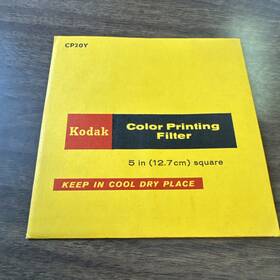
( Brand: Kodak ), ( Manufacturer Part Number: CP20Y ), ( Part Type: Filter ), ( Filter Shape: Square ), ( Filter Color: Yellow ), ( Square/rectangular Size: 5x5 In ), ( Filter Effects: Color Compensating ), ( Country Of Origin: United States )
Review KODAK Color Printing Gelatin Filter Inch Square New Old Stock
The **Kodak CP20Y Printing Gelatin Filter Square** is a precision-engineered photographic accessory designed to elevate the quality and consistency of traditional darkroom printing, particularly for those working with analog film and paper. Crafted from high-grade gelatin, this filter square is meticulously formulated to deliver uniform light diffusion and subtle tonal adjustments, making it an indispensable tool for photographers seeking refined control over their prints. Measuring precisely 20 inches by 20 inches, the filter is engineered to fit seamlessly within most standard enlarger heads, ensuring a snug and stable placement that minimizes light leakage and maintains optimal exposure accuracy. Its gelatin composition allows for a soft, even dispersion of light, reducing harsh shadows and halation while enhancing the subtle gradations of contrast in both high-key and low-key images. Ideal for fine-art photographers, archival printmakers, and enthusiasts working with black-and-white or sepia-toned processes, this filter square excels in applications where delicate tonal shifts and a velvety, film-like quality are desired. Whether used to soften the edges of a portrait, smooth out the transitions in a landscape, or achieve a vintage aesthetic reminiscent of classic printing techniques, the Kodak CP20Y delivers professional-grade results with remarkable consistency. Its durability and resistance to warping or degradation over time make it a long-term investment for those committed to the art of analog printing, ensuring that every print retains the integrity and depth intended by the original negative.
**Pros and Cons of buying a Kodak CP20Y Printing Gelatin Filter Square**
The Kodak CP20Y is a traditional gelatin filter square designed for use in darkroom printing, particularly with analog cameras and film. Below is a detailed breakdown of its advantages and disadvantages.
### **Pros**
1. **Authentic Analog Experience** The CP20Y replicates the look of classic photographic filters, allowing photographers to achieve vintage or artistic effects that digital alternatives may not fully replicate. It is particularly useful for creating sepia tones, softening edges, or adding subtle color shifts.
2. **Versatility in Printing** Gelatin filters can be used in various ways, such as:- **Direct printing** Placed between the enlarger lens and the photographic paper to modify light before exposure.
- **Contact printing** Used with a light source to tint or modify the appearance of negatives or transparencies.
- **Dye transfer or alternative processes** Some experimental photographers use them in non-silver processes for unique results.
3. **Durability and Longevity** Kodak gelatin filters are known for their stability over time, provided they are stored properly (in a cool, dry place away from direct sunlight). Unlike digital filters, they do not degrade with use, making them a long-term investment.
4. **Consistent Results** Since gelatin filters are physical media, they provide predictable color shifts and tonal adjustments, which can be difficult to achieve with digital post-processing.
5. **Educational Value** For photographers learning traditional darkroom techniques, using a CP20Y helps develop an understanding of light manipulation, color theory, and analog workflows.
6. **Compatibility with Multiple Enlargers** The filter square is designed to fit standard enlarger bellows, making it adaptable to various setups without requiring specialized equipment.
7. **No Digital Artifacts** Unlike digital filters, which can introduce banding or compression artifacts, gelatin filters produce smooth, organic transitions in tone and color.
---
### **Cons**
1. **Limited Color Range** The CP20Y is a single filter with a specific effect (typically a warm or neutral tint). Unlike digital filters, you cannot combine multiple effects in one exposure. For broader color adjustments, you would need to purchase additional filters (e.g., blue, green, or red squares).
2. **Requires Darkroom Access** Unlike digital filters, which can be applied post-capture, the CP20Y must be used during printing. This means you need access to a darkroom, enlarger, and photographic paper, which may not be practical for all photographers.
3. **Learning Curve** Using gelatin filters effectively requires an understanding of exposure compensation, filter placement, and how different filters interact with film and paper. Beginners may struggle to achieve desired results without experimentation.
4. **Physical Storage and Handling** Gelatin filters are delicate and must be stored flat to prevent warping or cracking. They can also be damaged by moisture, dust, or improper handling, which may shorten their lifespan.
5. **No Adjustable Intensity** Digital filters allow for real-time adjustments to opacity or saturation. With the CP20Y, the effect is fixed you cannot dial in subtle or extreme variations without purchasing multiple filters.
6. **Cost Relative to Digital Alternatives** While a single gelatin filter is inexpensive, purchasing multiple filters to achieve a range of effects can add up. For photographers who frequently experiment with color, digital filters may offer more flexibility at a lower long-term cost.
7. **Limited to Analog Workflows** If your primary focus is digital photography, the CP20Y offers little practical use outside of printing from film negatives or experimenting with alternative processes.
---
### **Conclusion**
The Kodak CP20Y Printing Gelatin Filter Square is a specialized tool best suited for photographers who prioritize traditional darkroom techniques, vintage aesthetics, or experimental printing methods. Its strengths lie in its authenticity, durability, and the unique tonal qualities it imparts to prints. However, it is not a versatile or convenient solution for modern digital workflows, and its use is limited to those with access to a darkroom and an interest in analog processes.
For photographers who enjoy the tactile and historical aspects of gelatin filters, the CP20Y is a worthwhile addition to their toolkit. However, those seeking flexibility, ease of use, or a broader range of effects may find digital alternatives more practical.
---
### **Recommendation**
**Buy the Kodak CP20Y if:**- You are a film photographer or darkroom enthusiast looking to enhance prints with subtle color shifts or vintage tones.
- You enjoy experimenting with traditional printing techniques and appreciate the physicality of gelatin filters.
- You have access to a darkroom and are willing to invest time in learning how to use the filter effectively.
- You prefer the organic, non-digital aesthetic that gelatin filters provide.
**Avoid the Kodak CP20Y if:**- You primarily work digitally and do not have a darkroom setup.
- You need a wide range of color adjustments without purchasing multiple filters.
- You prefer quick, adjustable, and non-destructive editing (e.g., digital filters in Lightroom or Photoshop).
- You are on a tight budget and could achieve similar effects with less expensive or more versatile alternatives.
**Alternative Considerations:**- If you want to explore gelatin filters without committing to a single type, consider purchasing a **filter set** (e.g., Kodak s CP20 series includes multiple colors).
- For digital photographers, **Photoshop actions** or **Lightroom presets** can mimic some of the effects of gelatin filters.
- If you are interested in alternative processes (e.g., cyanotype, gum bichromate), gelatin filters can be used in those contexts as well, but additional research and materials may be required.
Ultimately, the CP20Y is a niche but rewarding tool for those connected to the analog side of photography. Its value depends on your workflow, interests, and willingness to embrace traditional methods.
Details:
Made by Kodak in the USA, this yellow filter is perfect for enhancing color accuracy and vibrancy printed images. The Kodak CP40Y Color Printing Gelatin Filter is a 5 square filter designed for color compensating effects in photography. The square shape and size of 5x5 inches make it compatible with a variety camera lenses filters, providing photographers reliable high-quality option for their printing needs.
part #: cp20y prices
- $10.95-$19.99
specifications filtecam:
- brand: Kodak
- mpn: Cp20y
- part type: Filter
- filter shape: Square
- filter color: Yellow
- square/rectangular size: 5x5 In
- filter effects: Color Compensating
- country of origin: United States
returns filtecam:
- method: Money back
- policy: Returns Accepted
- time: 30 Days
- paid by: Buyer
general filtecam:
- condition: New
- Cameras Photo > Lenses Filters > Filters
payments filtecam:
- wallet: Apple-pay
- other
- credit card: Diners-club
seller filtecam:
- # reviews: 1213
- rating: 99.7%
- city: Yuba City, California
shipping filtecam:
- type: Calculated
- class: Standard
- cost: $11.35
- carrier: USPS
- service: USPS Ground Advantage
- transit: 5-9 Days
offer filtecam:
- started: May 4, 2026
- sold: 0
- options: Ship-to-home
- best offers: True
- availability: In Stock
- quantity: 1
Kodak CP20Y Is Similar To:
- S 878g 806y 855 Kodak Gelatin Filters Frame Green Blue Yellow (43.6% similar) Open envelopes, unknown if used or not. For Kodak adjustable filter holder and gelatin frame blue. No y yellow. Up for sale is a mixed lot of 3 Kodak gelatin filters frame 2-INCH, green, blue, yellow. 878 g green, no. Come from a college...(September 20th, 2018)
- 0041771496791 Kodak Color Compensating Filter Lot Of New Factory (48.9% similar) Lot includes 12 filters: CC05Y, CC10Y, CC20Y, CC30Y, CC05M, CC10M, CC20M, CC30M, CC05C, CC10C, CC20C and CC30C. All factory sealed. Filters new, old stock. Kodak color compensating filter lot of 12, new, factory sealed...(May 21st, 2018)
- 0049383034523 Harrison Light Correction Filter Kodak Case (29.7% similar) 2 Harrison B-5 color correction filter Kodak case excellent condition no scratches glass clear includes with screw-on lid...(April 1st, 2018)
- 04177170766 Kodak Yellow Color Compensating Wratten Gel Filter (43.6% similar) USA shipping only and will include delivery confirmation. Comes from a smoke free home...(June 9th, 2018)
- 0993 Kodak Camera Supplies Gray Cards Kalimar Ultra Violet Filter (35.3% similar) Camera supplies Kodak gray cards Palomar ultra violet filter w case condition: see pics the is in original box and does not have any signs of wear - I might been used, package has opened but they are great condition...(April 25th, 2018)
- 1401215 Kodak No Color Compensating Filter (44.2% similar) Kodak no CC025R cat color compensating filter measurements 3 x return shipping paid by buyer...(April 5th, 2018)
- 148-6638 Kodak Gelatin Filter Frame (43.4% similar) I only have three remaining and at this price they won't last long. Two piece metal frame. Kodak gelatin filter frame - brand new holds 3X3 gel filters...(December 18th, 2017)
- 149 6066 Kodak Wratten Filter Inch Sealed Free Ship (47.5% similar) New - un opened...(March 30th, 2018)
- 149 6173 Kodak Wratten Filter Inch Sealed Nos Gelatin Free Ship (38.8% similar) 85B color conversion filter. New old stock. Envelope seal is intact...(April 8th, 2018)
- 149 6363 Kodak Wratten Gelatin (33.7% similar) 60 written gelatin filter 75MM x 75MM square 3 cat Kodak new...(October 30th, 2017)
- 149 7353 Kodak Wratten Gelatin Neutral Density Nd Filter New (42.7% similar) Part: 100MM prices...(August 10th, 2018)