EDMUND OPTICS 86624 Cwl Fwhm Interference Filter 442NM 50MM Dia. 10NM
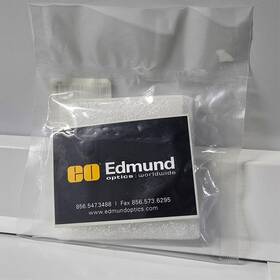
( Brand: Edmund Optics ), ( Manufacturer Part Number: 86624 ), ( Part Type: Filter ), ( Filter Shape: Circular ), ( Filter Color: Blue ), ( Unit Type: Unit ), ( Filter Effects: Bandpass Filter ), ( Filter Size: 50mm )
Review EDMUND OPTICS 442nm Cwl 50mm Dia. 10nm Fwhm Interference Filter New
The **Edmund Optics 86624 442 nm Center Wavelength (CWL) Interference Filter** is a precision-engineered optical component designed for demanding applications requiring ultra-narrowband spectral isolation with exceptional clarity and efficiency. Centered at a wavelength of **442 nanometers**, this filter is optimized for high-performance imaging, spectroscopy, fluorescence microscopy, and laser-based experiments where precise light manipulation is critical. With a **50-millimeter diameter**, it offers a generous clear aperture, making it suitable for a wide range of optical setups, from compact benchtop systems to larger-scale instrumentation. The filter s **10-nanometer Full Width at Half Maximum (FWHM)** bandwidth ensures an exceptionally sharp transmission peak, allowing for the isolation of a very specific wavelength range while effectively rejecting stray light outside this narrow spectral window. This characteristic is particularly valuable in applications where background noise must be minimized, such as in fluorescence detection or high-resolution spectral analysis.
Constructed with high-quality optical materials, the **86624** delivers a peak transmission efficiency of **greater than 80%**, ensuring maximum throughput of the desired 442 nm light while maintaining a steep roll-off on either side of the passband. The interference coating technology employed in its fabrication guarantees low absorption and scattering losses, contributing to the filter s overall reliability and longevity. Its **air-spaced design** further enhances durability, making it resistant to environmental factors such as humidity and thermal fluctuations, which could otherwise degrade performance over time. The filter s **uncoated back surface** simplifies integration into optical systems, as it eliminates the need for additional anti-reflection coatings on the non-functional side, reducing potential reflections and improving overall system performance.
Ideal for applications in **UV spectroscopy, mercury lamp filtering, and blue laser-based experiments**, this filter excels in scenarios where the precise control of light is paramount. Whether used in scientific research, industrial metrology, or advanced imaging systems, the **Edmund Optics 86624** provides a robust and high-precision solution for isolating the 442 nm wavelength with minimal spectral leakage. Its combination of **broad compatibility with standard optical mounts**, **superior optical quality**, and **reliable performance** makes it a versatile choice for engineers, researchers, and technicians seeking a dependable interference filter for their optical experiments.
The Edmund Optics 86624 442 nm Center Wavelength (CWL) interference filter with a 50 mm diameter and 10 nm Full Width at Half Maximum (FWHM) is a specialized optical component designed for precise wavelength isolation. Below is a detailed breakdown of its pros and cons, followed by a conclusion and recommendation.
---
### **Pros:**1. **High Optical Quality and Precision**
The filter is manufactured to strict specifications, ensuring a narrow bandwidth (10 nm FWHM) centered at 442 nm. This makes it ideal for applications requiring high spectral purity, such as fluorescence microscopy, laser line isolation, or specific wavelength excitation in scientific experiments. The tight bandwidth minimizes unwanted light from neighboring wavelengths, improving signal clarity.
2. **Durable and Stable Performance**
Edmund Optics uses high-quality materials and coatings, typically designed to withstand prolonged exposure to light without significant degradation. The filter is likely constructed with substrates like fused silica or optical glass, which offer excellent thermal and mechanical stability. This ensures consistent performance over time, especially in controlled laboratory environments.
3. **Broad Compatibility**
The 50 mm diameter is a standard size that fits many optical mounts, filter wheels, and imaging setups. This makes it versatile for integration into existing systems without requiring custom modifications. Additionally, the 442 nm CWL is a common wavelength for applications such as mercury lamp excitation (e.g., in fluorescence microscopy) or blue laser line isolation.
4. **High Transmission at Peak Wavelength**
Interference filters like this one are designed to maximize transmission at the center wavelength while blocking others. The 442 nm filter will typically transmit over 90% of the light at its peak, making it efficient for applications where maximizing signal strength is critical.
5. **Blockage of Unwanted Wavelengths**
The narrow bandwidth (10 nm) ensures that only a very specific range of wavelengths passes through, effectively blocking adjacent spectral regions. This is particularly useful in applications where stray light or background noise could interfere with measurements, such as in spectroscopy or imaging.
6. **Cost-Effective for High-Precision Needs**
While interference filters can be expensive, this Edmund Optics model offers a balance between performance and cost for many research and industrial applications. It is likely more affordable than custom or high-end alternatives while still meeting rigorous standards.
7. **Easy to Use with Standard Optical Tools**
The filter can be mounted using standard optical hardware, such as filter holders or kinematic mounts, without requiring specialized equipment. This simplifies integration into optical benches or imaging systems.
---
### **Cons:**1. **Narrow Application Range**
The filter is highly specialized for 442 nm applications. If your project requires a different wavelength or bandwidth, this filter will not be useful. For example, if you need a broader bandwidth or a different center wavelength, you would need to purchase a separate filter, adding to costs and complexity.
2. **Sensitivity to Angle of Incidence**
Interference filters are angle-sensitive; their performance degrades if the light is not incident perpendicular to the filter surface. Even small deviations from normal incidence can shift the transmission peak and reduce efficiency. This requires careful alignment in optical setups, which may add complexity to the system design.
3. **Potential for Damage from High Intensities**
While designed for typical laboratory use, prolonged exposure to high-intensity light sources (e.g., powerful lasers) can damage the coating or substrate. This filter is likely not rated for continuous high-power applications without additional cooling or protection, which may require additional components and cost.
4. **Limited Durability in Harsh Environments**
If used in environments with high humidity, dust, or temperature fluctuations, the filter s performance or longevity could be compromised. The coating may degrade over time, or condensation could affect optical clarity. Proper housing and environmental controls may be necessary for long-term use.
5. **Cost Relative to Simpler Filters**
Compared to broad-bandpass filters or simple colored glass filters, this interference filter is more expensive. For applications where high precision is not critical, a cheaper alternative might suffice. However, the cost is justified for many scientific and high-precision applications.
6. **Requires Proper Handling**
Optical filters are delicate and can be scratched or damaged by improper handling. They must be cleaned with appropriate techniques (e.g., using lens cleaning solutions and microfiber cloths) to avoid damaging the coating. Mishandling can reduce the filter s lifespan or performance.
7. **Potential for Polarization Effects**
Some interference filters can exhibit polarization-dependent behavior, where transmission varies with the polarization state of the incoming light. While this is less common in high-quality filters like this one, it is something to consider if your application involves polarized light sources or detectors.
---
### **Conclusion:**The Edmund Optics 86624 442 nm interference filter is an excellent choice for applications requiring precise wavelength isolation at 442 nm with a narrow bandwidth. Its high optical quality, durability, and compatibility with standard optical setups make it a reliable tool for scientific research, microscopy, and laser-based experiments. However, its specialized nature means it is not suitable for applications requiring different wavelengths or broader bandwidths. Additionally, its angle sensitivity and potential vulnerability to high-intensity light or harsh environments require careful handling and system design.
---
### **Recommendation:** Purchase this filter if:- You are working with a 442 nm light source (e.g., mercury lamp or blue laser) and need to isolate this wavelength with minimal spectral contamination.
- Your application demands high spectral purity, such as in fluorescence imaging, spectroscopy, or precise laser line isolation.
- You have a well-controlled optical setup where the filter can be aligned perpendicular to the light path.
- You are willing to invest in a high-quality, durable filter that will provide consistent performance over time.
Avoid purchasing this filter if:- You require a different center wavelength or bandwidth, as this would necessitate a separate filter.
- Your setup involves high-intensity light sources without proper cooling or protection, as this could damage the filter.
- You are working in an environment with significant dust, humidity, or temperature fluctuations without adequate protection.
- Your budget is constrained, and a simpler or broader-bandpass filter would suffice for your needs.
For most research-grade applications where 442 nm isolation is critical, this filter is a strong and cost-effective choice. If unsure about compatibility, consult with Edmund Optics technical support or a specialist in optical filtering to ensure the filter meets your specific requirements.
Details:
part #: 86624 price
- $249.99
specifications filtecam:
- brand: Edmund Optics
- mpn: 86624
- part type: Filter
- filter shape: Circular
- filter color: Blue
- unit type: Unit
- filter effects: Bandpass Filter
- filter size: 50mm
offer filtecam:
- quantity: 3
- sold: 0
- best offers: True
- options: Ship-to-home
- started: May 30, 2026
- availability: In Stock
seller filtecam:
- rating: 0.0%
- city: Newport Beach, California
- # reviews: 35
payments filtecam:
- other
- credit card: Diners-club
- wallet: Google-pay
general filtecam:
- condition: New
- Cameras Photo > Lenses Filters > Filters
shipping filtecam:
- service: UPS Ground
- cost: $9.42
- carrier: UPS
- type: Calculated
- transit: 5-11 Days
- class: Standard
returns filtecam:
- policy: No Returns
Edmund Optics 86624 Is Similar To:
- Hoya 54763 Hmc Filter 25a 49mm Mtd Red 49x0.75 Edmund Optics (19.5% similar) Part #: hiya 54763 for sale...(January 14th, 2025)
- Edmund Optics 66-241 Genuine 1100nm Longpass Filter 25mm High Performance Od4 (49.3% similar) 25MM diameter high performance OD4 in rejection band Edmund Optics part number: #66-241 spent its entire life mounted an enclosed filter wheel. Only ever cleaned with gentle compressed air. Used but indistinguishable from new Edmund Optics 1100NM long pass filter...(January 31st, 2025)
- Edmund Optics 59-770 Rs-232 59-769 Ifw Motorized Filter Wheel 8x 25mm Holder (43% similar) The control box still has the filter names programmed into it for filters that were previously loaded. Selling a lightly used, fully-functional Edmund Optics OPEC is the original manufacturer 59-769 RS-232 motorized filter wheel with hand control, along 59-770 8-POSITION holder for 1/2 5MM diameter ...(January 31st, 2025)
- Edmund Optics 84-889 Optics optec Hswf Filter Wheel Working Custom Backplate No Supply (37.7% similar) Tested and working Edmund Optics/OPEC hspf filter wheel part number 84-889. This was installed in an optical bench setup that saw light use, but it has a couple of quirks: as with the power supply, I can't find original stock back plate. Without a filter wheel installed, it gives an error saying can...(March 20th, 2025)
- Edmund Optics 48-515 1x 5 Diffusing Angle Holographic Diffuser 50mm Pn (35% similar) Physical mechanical properties. Environmental durability factors. One 1x Edmund optics 50MM 5 diffusing angle holographic diffuse. These UV fused silica holographic diffuses use fused silica substrate enabling their at higher operating temperature holographic diffuses and offer controlled, ...(June 2nd, 2025)
- Edmund Optics 62-663 1x 0.5 Od 50mm Diameter Uv-vis Nd Filter Pn (56.9% similar) Physical mechanical properties. Type: natural density filter. Ideal for 250-700NMSOURCES. New, unopened in package. Tech spec UV-ventral density nd filters are spectral flat from 250 to 700NM and feature outstanding parallelism surface characteristics. Optical densities ranging from 0.3 to 3.0. ...(June 3rd, 2025)
- Edmund Optics 48-519 1x 25 Diffusing Angle Holographic Diffuser 50mm Pn (34.7% similar) Diameter mm: 50.00 0.1. Standard also available. Fused silica substrate ideal for high temperatures. Zero order, or a secular component, of transmitted light is less than 1% for visible wave length s, but may be higher if these diffuses are used at wave lengths outside the range of 200 - 1500NM. ...(June 3rd, 2025)
- Edmund Optics 48-513 1x 0.5 Diffusing Angle Holographic Diffuser 50mm Pn (34.5% similar) Threading mounting. Immediately and carefully blow off the clean with dry compressed air. Fused silica substrate ideal for high temperatures. Specifications. Physical mechanical properties. To clean holographic diffuses, dampen a lint free cloth wipe with methanol and gently the entire diffuse ...(June 3rd, 2025)
- Edmund Optics 84-904 Longpass Filter 570nm 12.5mm Diameter New Sealed Packaging (39.5% similar) Perfect for use in fluorescence microscopy, spectroscopy, laser applications, and other precision optical systems. Country of origin: made in USA. Machine vision. Manufacturer: Edmund Optics. Brand new, unused Edmund Optics long pass optical filter, part number 54-656. Filter type: long pass. This ...(June 17th, 2025)
- Miniature Motorized Filter Wheel 88171 Edmund Optics 88-171 25 25.4mm 6 Position (31% similar) This unit is ideal for laboratory, research, phonics, imaging, and optical testing applications requiring precise, automated filter selection. New Edmund Optics 88-171 25/25.4MM 6 position motorized filter wheel - in original box,: up for sale is a brand new, box wheel, designed to accommodate 25MM ...(July 1st, 2025)
- Edmund Optics 43-057 New Eo 436nm Cwl 10nm Fwhm 11.8mm Dia Bandpass Interference Filter Hg Emissi (63.5% similar) Typical applications: Hg emission. Bandpass filter...(August 23rd, 2025)